

 3.4Mb
3.4MbScience
– a Universal Discipline
Science is an active process, drawing upon and contributing to a growing
and changing body of knowledge. It is a universal discipline that involves
using knowledge, understandings, skills and imagination to tackle problems
and to investigate objects and events of the real world. A science education
encourages students to have enquiring minds and to make sense of the actions
and interactions of the biological and physical features of their environment.
Science
and the National Curriculum
Science education represents part of a balanced curriculum for all New
Zealand school students. The science curriculum is organised into four
major areas of learning which are intended to help students make sense
of the living world, the physical world, the material world, and planet
Earth and beyond. Since science is both a process of enquiry and a body
of knowledge, the curriculum also requires that students are helped to
develop scientific ideas, skills and attitudes, and “acquire an
understanding of the nature of science and its relationship to technology”.
Within the major areas of content, the aims of a science education include
the development of knowledge and understanding, skills of scientific
investigation, and attitudes on which such investigation depends. Science
is promoted as an activity that is carried out by people as part of their
everyday life. Students are to be helped to “explore issues and
to make responsible and considered decisions about the use of science
and technology in the environment”.
Framework
for National Monitoring Assessment of Students' Knowledge,
Skills and Attitudes in Science
NEMP task frameworks are developed by the Project’s curriculum
advisory panels. They have two key purposes: to provide a valuable guideline
structure for the development and selection of tasks, and to bring into
focus important dimensions of the learning domain that should be included
in valid analyses of students’ knowledge, skills and attitudes.
The frameworks are organising tools that interrelate main ideas, processes
and attitudes with reference to important learning outcomes. They are
intended to be flexible and broad enough to encourage and enable the
development of tasks that lead to meaningful descriptions of what students
know and can do.
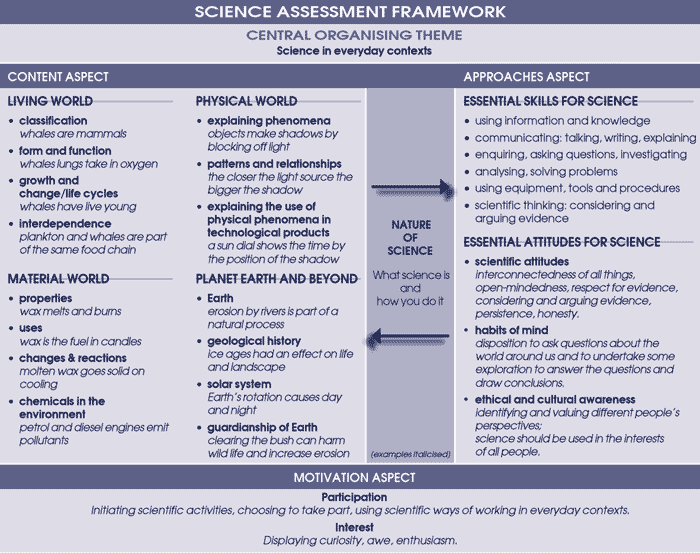
The science framework has a central organising theme supported by three
interrelated aspects. The central organising theme, “Science
in everyday contexts”, sets the broad context for tasks and is
consistent with the aims of New Zealand’s official science curriculum.
| Learning in science is fundamental to understanding the world in which we live and work. It helps people to clarify ideas, to ask questions, to test explanations through measurement and observation, and to use their findings to establish the worth of an idea. |
Science
in the New Zealand Curriculum, 1993 |
 |
The
Choice of Science Tasks for National Monitoring
The choice of science tasks for national monitoring is guided by a
number of educational and practical considerations. Uppermost in any
decisions relating to the choice or administration of a task is the
central consideration of validity and the effect that a whole range
of decisions can have on this key attribute. Tasks are chosen because
they provide a good representation of important dimensions of a science
education, but also because they meet a number of requirements to do
with their administration and presentation. For example:
• Each task with its associated materials needs to be structured to ensure a high level of consistency in the way it is presented by specially trained teacher administrators to students of wide- ranging backgrounds and abilities, and in diverse settings throughout New Zealand.
• Tasks need to span the expected range of capabilities of year 4 and 8 students and to allow the most able students to show the extent of their abilities while also giving the least able the opportunity to show what they can do.
• Materials for science tasks need to be sufficiently portable, economical, safe and within the handling capabilities of students. Visual items need to depict images and contexts that have meaning for students.
• The time needed for completing an individual task has to be balanced against the total time available for all of the assessment tasks, without denying students sufficient opportunity to demonstrate their capabilities.
• Each task needs to be capable of sustaining the attention and effort of students if they are to produce responses that truly indicate what they know and can do. Since neither the student nor the school receives immediate or specific feedback on performance, the motivational potential of the assessment is critical.
• Tasks need to avoid unnecessary bias on the grounds of gender, culture or social background while accepting that it is appropriate to have tasks that reflect the interests of particular groups within the community.
National
Monitoring Science Assessment Tasks
Sixty-six science tasks were administered, using three different
approaches. Thirty-eight tasks were administered in one-to-one interview
settings, where students used materials and visual information. Nine
tasks were presented in team situations involving small groups of
students working together. Nineteen tasks were attempted in a stations
arrangement, where each student worked independently on a series
of paper-and-pencil tasks, many of which included the use of hands-on
materials or visual information.
Fifty-two of the 66 tasks were the same or substantially the same
for both year 4 and 8, while five tasks were unique to year 4 and
nine tasks unique to year 8.
Trend
Tasks
Twenty-five of the tasks in this report were previously used in identical
form in the 1999 assessments. These were called link tasks in
the 1999 report, but were not described in detail to avoid any distortions
in 2003 results that might have occurred if the tasks had been widely
available for use in schools since 1999. In the current report, these
tasks are called trend tasks and are used to examine trends
in student performance: whether they have improved, stayed constant or
declined over the four-year period since the 1999 assessments.
Link
Tasks
To allow comparisons of performance between the 2003 and 2007 assessments,
29 of the tasks used for the first time in 2003 have been designated link tasks.
Student performance data on these tasks are presented in this report,
but the tasks are described only in general terms because they will be
used again in 2007.
National
Monitoring Science Survey
Additional to the assessment tasks, students completed a questionnaire
that investigated their interests, attitudes and involvement in science
activity.
Marking
Methods
The students’ responses were assessed using specially designed
marking procedures. The criteria used had been developed in advance
by Project staff, but were sometimes modified as a result of issues
raised during the marking. Tasks that required marker judgement and
were common to year 4 and year 8 were intermingled during marking sessions,
with the goal of ensuring that the same scoring standards and procedures
were used for both.
Task
by task reporting
National monitoring assessment is reported task by task so that results
can be understood in relation to what the students were asked to do.
Access
Tasks
 Teachers
and principals have expressed considerable interest in access to NEMP task
materials and marking instructions, so that they can use them within their
own schools. Some are interested in comparing the performance of their own
students to national results on some aspects of the curriculum, while others
want to use tasks as models of good practice. Some would like to modify tasks
to suit their own purposes, while others want to follow the original procedures
as closely as possible. There is obvious merit in making available carefully
developed tasks that are seen to be highly valid and useful for assessing
student learning.
Teachers
and principals have expressed considerable interest in access to NEMP task
materials and marking instructions, so that they can use them within their
own schools. Some are interested in comparing the performance of their own
students to national results on some aspects of the curriculum, while others
want to use tasks as models of good practice. Some would like to modify tasks
to suit their own purposes, while others want to follow the original procedures
as closely as possible. There is obvious merit in making available carefully
developed tasks that are seen to be highly valid and useful for assessing
student learning.
Some of the tasks in this report cannot be made available in this way.
Link tasks must be saved for use in four-years’ time, and other tasks
use copyright or expensive resources that cannot be duplicated by NEMP
and provided economically to schools. There are also limitations on how
precisely a school’s administration and marking of tasks can mirror
the ways that they are administered and marked by the Project. Nevertheless,
a substantial number of tasks are suitable to duplicate for teachers and
schools. In this report, these access tasks are identified with the symbol
above, and can be purchased in a kit from the New Zealand Council for Educational
Research (P.O. Box 3237, Wellington 6000, New Zealand).
Teachers are also encouraged to use the NEMP web site (http://nemp.otago.ac.nz)
to view video clips and listen to audio material associated with some of
the tasks.