|
8. THE HALPERN THINKING ASSESSMENT TASKS |
|
|
| 8.1
INTRODUCTION |
In
this section the tasks in the assessments which seem to have the greatest
potential for assessing the four different kinds of thinking are discussed.
As stated in section 1.4 of this report, the researcher shares the
view of Halpern (2003, page 361) that the type of test format most
suited to the assessment of thinking uses: |
| |
| • |
an open-ended response format
|
| • |
specific questions that probe the reasoning behind an answer
|
| |
|
|
|
|
There
are many tasks in the NEMP assessments which clearly involve one,
or more, of the categories of thinking in which we are interested,
but which only examine the results of that thinking and not the processes
through which the student went to achieve those results. That is,
they fail to satisfy the second, of Halpern’s criteria.
The only task format which is likely to satisfy both of the criteria
is the one-to-one interview format in which the student works individually
with a teacher with the whole session recorded on videotape. The team
and independent also involve some videotaping, but there is not the
same opportunity for probing the student’s reasoning in these
formats.
Consequently, the only NEMP tasks which seem to satisfy Halpern’s
criteria are those which: |
| |
|
• |
are in a one-to-one interview format |
|
• |
are open-ended |
|
• |
ask for explanations or justifications |
| |
|
For
want of a better word such tasks will be referred to as Halpern tasks.
Whether or not the potential of these tasks was realised in the marking
and reporting of the tasks is also considered. |
| |
| 8.2
THE DISTRIBUTION OF HALPERN THINKING TASKS |
| The
table below indicates: |
| |
|
| • |
the subject area |
| • |
the number of tasks judged to involve each of the forms of thinking |
| • |
the number of Halpern thinking tasks for each form of thinking |
| • |
the total number of thinking tasks and Halpern thinking tasks. |
| • |
the number of Halpern thinking tasks in which the potential was realised
in the marking and reporting criteria |
| |
| |
| |
Number
of thinking tasks |
Number
of Halpern tasks |
| Subject
|
Critical
|
Creative
|
Reflective |
Logical |
Critical |
Creative |
Reflective |
Logical |
| Science
|
2 |
1 |
5 |
14 |
2 |
0 |
1 |
1 |
| Art
|
5 |
10 |
4 |
0 |
5 |
0 |
4 |
0 |
| GTM
|
1 |
0 |
2 |
3 |
0 |
0 |
0 |
0 |
| Music
|
0 |
8 |
1 |
0 |
0 |
0 |
1 |
0 |
| Tech
|
5 |
1 |
3 |
6 |
2 |
0 |
0 |
2 |
| Read/Speak
|
0 |
6 |
6 |
2 |
0 |
0 |
0 |
0 |
| Info
Skills |
0 |
0 |
6 |
2 |
0 |
0 |
0 |
1 |
| Soc
Studies |
0 |
0 |
6 |
1 |
0 |
0 |
0 |
0 |
| Maths |
0 |
0 |
0 |
10 |
0 |
0 |
0 |
0 |
| Listen/View
|
5 |
1 |
4 |
3 |
5 |
0 |
2 |
0 |
| Health/PE
|
1 |
0 |
14 |
0 |
0 |
0 |
3 |
0 |
| Writing
|
2 |
13 |
4 |
2 |
0 |
0 |
0 |
0 |
| Total |
21 |
40 |
55 |
43 |
14 |
0 |
11 |
4 |
| No
of Halpern tasks realising potential |
11 |
0 |
10 |
1 |
|
| |
| 8.3
DIFFERENCES RELATING TO THINKING CLASSIFICATION |
The
most obvious feature of this table is that although there were a good
number of tasks involving creative and logical thinking in the assessments,
none of the creative tasks and few of the logical tasks satisfied
the Halpern thinking task criteria.
In the creative tasks, only 5 of the 40 tasks used a one-to-one format
and the students were not asked to explain or justify their responses
in any of these. This is not surprising. From an assessment point
of view, it seems reasonable to assume that the creativity of an art
work, a piece of music, or a story can be judged by looking at the
end result. It would also be impractical and unnecessary to have a
teacher observing all the time an art work was being made or a story
written. However, in the art assessments, for example, there are some
excellent examples of students being asked to think critically and
reflectively on the work of others and it does seem that it would
be worthwhile to ask them to consider their own creativity in the
same way. Perhaps this is not practicable in the NEMP context, but
it should certainly be encouraged in the classroom.
The situation is a little different in the logical tasks. 13 of the
43 thinking tasks used the one-to-one format and there is no obvious
practical reason why this number could not have been greater. There
was some probing of reasoning, but the researcher felt that it was
relatively superficial and this is reflected in the fact that only
one of the Halpern logical tasks realised its potential. There is,
it seems, an unwarranted tendency to assume that if a student achieves
the correct answer for a question involving logical thinking then
the thinking must have been sound. There is also the fact that the
logical thinking tasks tend to be less open-ended than those involving
the other kinds of thinking.
In contrast, 16 of the 21 critical thinking tasks used the one-to-one
format and many of them made the most of the opportunities for open-ended
questions and response probing which this format provides. There is
little doubt that this is the area in which the NEMP assessments were
most successful in assessing the thinking of students.
In the reflective thinking tasks 26 of the 55 tasks used the one-to-one
format and the majority of these were open-ended. However, in a significant
number of tasks the responses of students were recorded but not probed. |
| |
| 8.4
SUBJECT AREA DIFFERENCES |
It
is clear from the above table that the distribution of Halpern thinking
tasks is not even over the different subject areas. It is important
to recognise in interpreting this that the NEMP assessments are not
principally designed to monitor thinking skills. If they do this it
is likely to be as a by-product of other objectives.
Graphs, Tables and Maps, Reading and Speaking, Information Skills,
Social Studies, and Mathematics, which contributed hardly any Halpern
tasks, perhaps tend to be less open-ended than other subjects and
consequently good thinking assessment tasks are less likely to arise
in the usual assessment patterns of these subjects. If thinking is
to be successfully assessed in these areas it seems that specific
questions might be required.
Because no creative thinking tasks fitted the Halpern criteria, the
more creative subjects of Art, Music, Reading and Speaking, and Writing
appear strongly on the table of tasks which involve thinking skills
but less strongly in the Halpern tasks than they might have done.
Science, Technology, and Listening and Viewing covered a wide range
of thinking tasks.
The thinking in Health and Physical Education was principally reflective
although in a number of tasks it seemed that the assessment was mostly
concerned with the student’s opinion rather than the thinking
behind that opinion.
The subject area which stands out most in the table is Art. In the
three assessments undertaken, there were 28 assessment tasks in total,
19 of these were judged to require thinking skills. 10 of these were
creative thinking tasks, not in the one-to-one format and consequently
not included in the Halpern tasks. However, there is little doubt
that the creative thinking of these tasks was evident in the work
which the students produced, even if the thinking was not probed.
Of the other 9 task all were in the Halpern task category. Only logical
thinking was missing. |
| |
| 8.5
TWO EXAMPLES OF VERY GOOD THINKING ASSESSMENT TASKS |
| The
two tasks which follow are, in the researcher’s opinion, examples
of the best thinking assessment tasks in the NEMP assessments. The
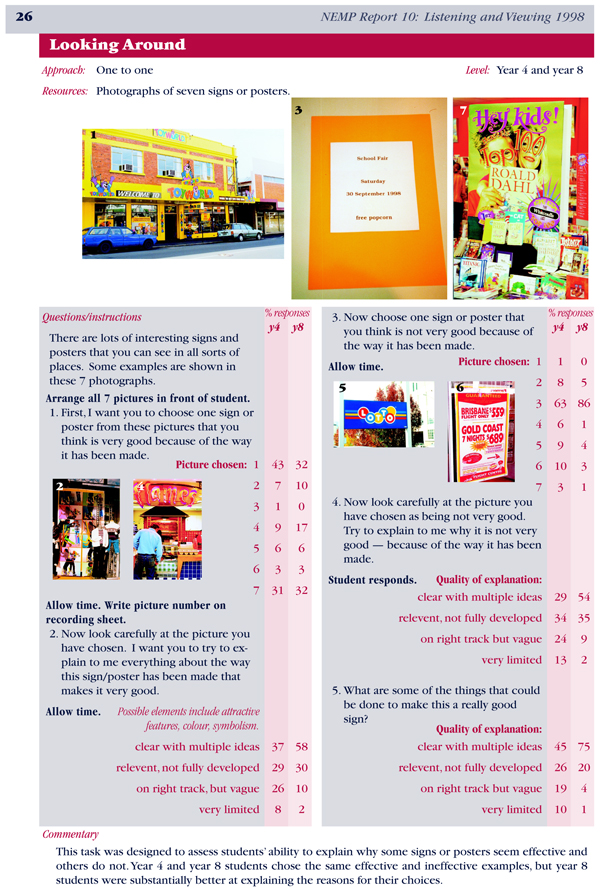
first is a critical thinking task taken from the 1998 Listening and
Viewing assessment. |
| |
|
 |
| |
| The
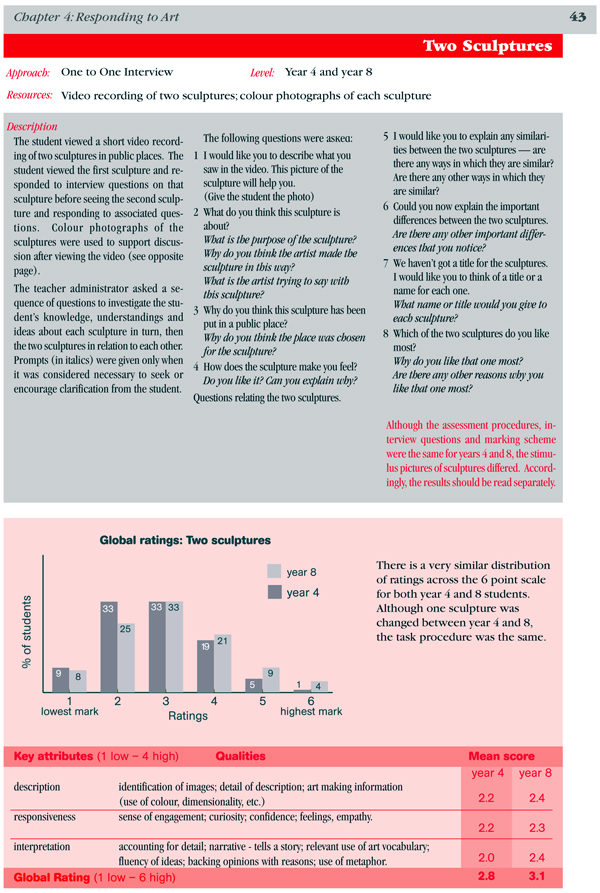
second is a reflective thinking task from the 1995 Art assessment. |
| |
|
 |
| |
| |
|
As
explained earlier, none of the creative thinking tasks involved
probing the thinking of students and none of the logical thinking
tasks stood out as being particularly good.
The first task
is clearly evaluative and consequently involves critical thinking.
The initial questions are open-ended, there is no 'correct' answer.
The students are then required to explain and justify their responses
and these explanations are evaluated in the marking criteria.
The second task
was considered to be predominately a reflective thinking task although
there is an evaluative element towards the end. The student is asked
to reflect on the sculptures; what they are about; why they are
there; how the sculptures make the student feel. These are clearly
open-ended questions the responses to which are probed - can you
explain why? The responses to these probes are clearly evaluated
in the marking criteria under the category of responsiveness. |
| |
| 9.
TASKS FOR FUTURE RESEARCH |
| |
The final research question for this study was:
Is it possible to identify particular tasks, presented in a one-to-one
interview format, the video tapes from which would be likely to enable
a researcher, in a subsequent study, to explore the nature of the
thinking which was actually used by students.
It does seems that it is possible. The tasks would need to be Halpern
tasks as discussed in the previous section and this would preclude
the creative thinking tasks. There did not seem to be any obvious
candidates in the logical thinking tasks either. However, the responses
to a number of the critical and reflective thinking tasks did appear
to be worthy of further examination.
The two tasks in section 8.5, for example, would both be suitable.
In both cases students were asked to explain or justify their responses.
The marking criteria then asked the assessors to classify the explanations: |
| |
| |
Task |
Marking
criteria |
|
| |
Looking
around |
Quality
of explanation: |
clear
with multiple ideas
relevant, not fully developed
on right track but vague
very limited |
| |
|
|
| Two
sculptures |
Responsiveness
(how it makes you feel) |
| |
sense of engagement
curiosity
confidence
feelings / empathy
|
| |
| |
slightly |
moderately |
highly
|
| underdeveloped |
developed |
developed |
developed |
|
| |
| A
further examination of the video tapes might enable a researcher to
focus on the nature of the thinking behind the responses as well as
judging their overall quality. There is almost certainly more useful
information in the video tapes than was used in the initial assessment. |
