|
a1.10
Feedback
|
| In
the previous section it was mentioned that NEMP staff watched video
tape from the first week of administrating. At the end of each week
of administrating in schools, the administrators send completed video
tapes and paper work of assessment data to NEMP in Dunedin. NEMP staff
viewed sections of each administrator working with students at the
end of the first week. Feedback is then given by NEMP staff to each
administrator. This feedback took the form of a general newsletter
to all administrators which included: general reminders of things
that administrators should be doing, for example, following the script
and procedures in the manual consistently, supplies being set out
before commencing each task; administrative issues that cause common
problems, for example, labelling tapes correctly, checking the microphone
is working, ensuring that the completion sheets are filled in correctly.
Information relating to administering specific tasks correctly is
included in this section if necessary. The teacher administrators
also received specific feedback on their administration. The feedback
was important to administrators as it provided them with a link to
the NEMP staff and reassured them that they have interpreted the role
correctly. If an administrator's performance required immediate attention,
a member of the NEMP staff contacted them by telephone. Most administrators
received feedback by the end of the second week, which enabled them
to focus on any issues and implement changes by the third week of
administrating. Some NEMP staff identified a need to be in contact
with administrators before this: |
| |
NEMP3:
|
I would like to put a call through to each pair in first week…24 pairs-
viable; could be shared around. It's a pastoral care function…it's
a harsh break from the training week to being out there. You can see
during training week that some of the pairs might want or need more
personal contact. A phone call gives the TAs an opportunity to talk
about what went well and any concerns or difficulties they may have.
Not everyone rings, and it is a mistake to assume that hearing nothing
means that all is well… |
| NEMP2: |
I would like to get, maybe…the report back to the TA's…you know how
they get a report on their performance… and it doesn't arrive until
the second week, which means it's not effective until the third week…
so it's a matter of seeing how they're going earlier on. If I'm very
concerned I ring up, as quickly as I can, though sometimes they're
not too keen on that, to get their first phone call, “Oh, you're doing
this wrong…”, is not too good for them, but that worries me a little
bit. It's often not until the third week that a problem is picked
up on… and sorted out. And I think that people like (NEMP staff member)
even find that with the returns and all that sort of thing, that things
haven't been returned the way they should…he's in the same situation
and he gets quite uptight in the first two weeks, but by the third,
you know, hopefully it's sorted out. |
|
|
|
|
|
| Administrators
look forward to receiving feedback and having their work corroborated
and getting suggestions for improvement. However, the feedback sent
out received a variety of responses: |
| TAJ14:
|
Really
appreciated the feedback |
| TAJ2:
|
It
was great to get the NEMP feedback…but know my administrating has
lapses. Trying to head to consistency! Newsletter was great too. |
| |
|
|
|
|
For
some administrators the feedback confirmed that they were performing
well in their new role, reinforcing the skills and ideas that they
had learned. Administrators who were aware of inconsistencies in
their execution of the role also welcomed the reminders and reinforcement.
However, it
was important that feedback was accurate in order to be meaningful.
There were some situations where teachers felt that they were fulfilling
certain aspects of their role that were subject to critical comment
on their feedback sheets. However, even if they disagreed with the
feedback given, it still served to focus the administrator's attention
onto particular aspects of their role: |
| TAJ6:
|
My
partner and I both got feedback sheets in the post on Friday and were
quite disheartened by them, as we have been striving to administer
to an excellent standard. Both of us were advised that our 'relationships
with children' needed attention. We were perplexed as the children
have seemed happy, relaxed and reluctant to finish sessions. We were
told not to rush into tasks before greeting children. We thought markers
would realize greeting and informal discussion had taken place prior
to pushing 'record'. We were trying to avoid making markers sit through
irrelevant stuff! |
| |
|
|
|
|
| For
many teachers the feedback enabled them to focus on skills and ideas
that they had forgotten or needed to consolidate in order to perform
their new role successfully: |
| TAJ5: |
The feedback I received was mostly positive - I was relieved. The
few suggestions I have been given with regard to language proved useful
and I am mindful of this as I interact with students. |
| TAJ3: |
Although I dreaded the feedback form and am cross with myself for
missing reading the instructions properly, it was good to be picked
up on it, even though I felt foolish. The feedback was positive too…it
encourages you to continue to aspire to be the best you can. |
| |
|
|
|
|
| A
number of administrators did not receive their feedback until after
several weeks of administrating. This was often the case when administrators
were working away from home for several weeks in a row and did not
return home at the weekends. In these instances teachers were frustrated
when they found that they were performing their role inadequately
and had continued to do so for some time. Teachers expressed a desire
to work effectively in the administrator role and welcomed information
that enabled them to adopt this role successfully: |
| TAJ10: |
I didn't go home at the end of week 2 and therefore didn't get my
feedback in the mail until the end of week 3, and that's over half
(the time) that I've been doing things wrong and didn't know. I will
have to work really hard to get it right for the last 2 schools. |
| TM5:
|
It
would have been useful to have the feedback sent to the next school
that we were going to. I didn't get mine until week 4 as I didn't
go back home until then, and I would have liked to have received it
sooner. |
| |
|
|
|
|
| It
appears from comments made by administrators that feedback on their
performance was important to them, to reassure or identify areas of
concern in regard to aspects of their performance, so that they could
confirm their perceptions of their role. It would therefore be beneficial
for administrators to have had the opportunity to practice their role
and receive feedback on their performance as they are learning about
the role, during their training week, to acknowledge good technique
and help them identify areas that need to be improved. This was suggested
by administrators when they identified the sort of practice they required
that would help them to perform more confidently in their new role.
For example: |
| TAJ13:
|
Thinking
about what I could be better prepared for…it's like we should have
done a few practice runs, and been observed and given feedback during
the training…it would have been useful. You don't realize you do things
unless you are told or you watch yourself on video. |
| |
|
|
|
|
Learning
is facilitated by regular ongoing feedback. Thus, feedback during
training would enable teachers to develop and refine their competence
with administrating before they are placed in the situation 'for
real'. Research conducted on the role of experiential learning,
especially in adult education (Dorn, 1989; Knowles 1977; Petranek,
1994) has shown that receiving feedback from different perspectives
during participatory methods of learning helps to anchor content
and transform behaviour. It also develops positive peer support
through the group's sharing of experiences, positive comments and
practical suggestions. Having had the opportunity to receive feedback
from their tutors and their peers and to give feedback to others,
may mean that administrators are better equipped to monitor their
own performance and also to provide constructive feedback to their
partner in the field. This may also help to alleviate some of the
partnership issues between administrators.
After viewing
the video from the first week of administrating, any feedback subsequently
provided by NEMP staff to administrators would be easier to give,
as administrators would be used to receiving constructive feedback
by this point. It would be worth posting written feedback to the
next school that the administrators are to work in, as suggested
by one administrator. This would avoid the difficulties of not receiving
mail that some administrators experience if they are working out
of their area and do not return home at weekends
The proposal
to put a phone call through to teacher administrators during their
first week could produce results similar to the 'Hawthorne effect'.
The Hawthorne effect refers to the phenomenon that mere attention
to employees can increase the quality of performance. It was the
result of a series of experiments conducted at Western Electric's
Hawthorne Works, in Illinois, which found that attention given to
workers (in this case by researchers) was perceived as respect and
interest in their activities and performance. Consequently, their
performance in their working role improved (Mayo, 1933). This effect
has had various interpretations, but there is a consensus that human
beings perform at higher levels when they are being attended to
respectfully by a perceived 'authority'. The time spent on a telephone
call to each administrator partnership may be time well spent if
it produces similar effects to those recorded. |
| |
|
|
|
|
| a1.11
The practical use of ICT equipment and the assessment process |
The
need to be competent and confident with ICT equipment had been perceived
by teachers as being important during various stages of the training
and administration process (Sections 1.2, 1.3, 1.7). The use of
ICT equipment is essential in NEMP assessment. Some of the assessment
tasks are implemented using a computer, in order to provide variation
in the delivery of tasks and in the way students respond to tasks.
Many of the assessment procedures are videotaped so that data that
can be analysed and marked at a later date. Teacher administrators
must learn to use these technologies and incorporate them into their
interactions with students. Learning the skills of using ICT equipment
is seen as a priority by teachers, prior to commencing their training.
This is shown in Figure 4, Section 2.
NEMP staff indicate
that learning about and using the ICT equipment is always perceived
by teachers as a challenge: |
| NEMP1:
|
The
part that teachers every year say is one of the most daunting and
challenging bits is the toys department; the cameras and the video
recorders; that throws a lot of teachers, and I can understand that.
I mean teachers do not spend a lot of time behind video cameras, and
using computers in classrooms. |
| NEMP2: |
The computer, video camera, that's the one they tend to come to me
about… electronics… “What happens if I don't record, or have no tape”…that's
what really worries them… |
| NEMP3:
|
Physical
equipment…computer and video they definitely find difficult. There
is a wide range of skills that teachers bring. Also, our equipment
is old… computers Mac., and our videos are not digital. There is also
time pressure on equipment sessions. |
| |
|
|
|
|
| Administrators
identified the use of ICT equipment as one of the three most important
skills they developed during their training week (Figure 5). For some
administrators, ICT equipment was one of the difficulties they encountered
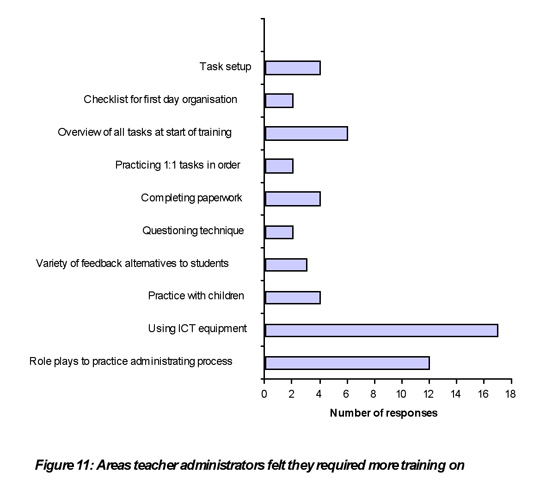
in implementing their TA role effectively (Figure 10). In Questionnaire
3, teachers indicated that the use of ICT equipment is an area that
they would like to have more training on. This is shown in Figure
11 below. |
 |
| However,
they were specific as to the sort of practice they required that would
enable them to use the equipment more confidently: |
| TA8-14: |
…I
felt that a lot of emphasis was placed on recording, and a lot of
the data depends on recording, so I felt that we should be able to
record it, and then play it back to see. Because what we're going
to do now is go out there and record stuff…we've only recorded a little
bit at a time… but if we've done like 5 minutes or 6 minutes of it
with our partner, then we would have felt more comfortable. |
| TAJ25: |
Perhaps we should have practiced more with a tape in the camera. I
did practice at home before week one, but there was no tape in the
camera. Maybe the TA trainees could watch a video of different set
ups and where the camera is placed, because part of the reason for
the mistake I made was that I had not set the room up well. |
| TAJ13:
|
Thinking
about what I could be better prepared for…it's like we should have
done a few practice runs, and been observed and given feedback during
the training…it would have been useful. You don't realize you do things
unless you are told or you watch yourself on video. Maybe we could
spend some time on Friday looking at some of the tapes done that week
and analyse strengths and weaknesses. |
| |
|
|
|
|
| In
order to develop confidence using the equipment in an authentic situation,
there were suggestions for the need to role play an assessment situation
in order for administrators to go through the procedure of setting
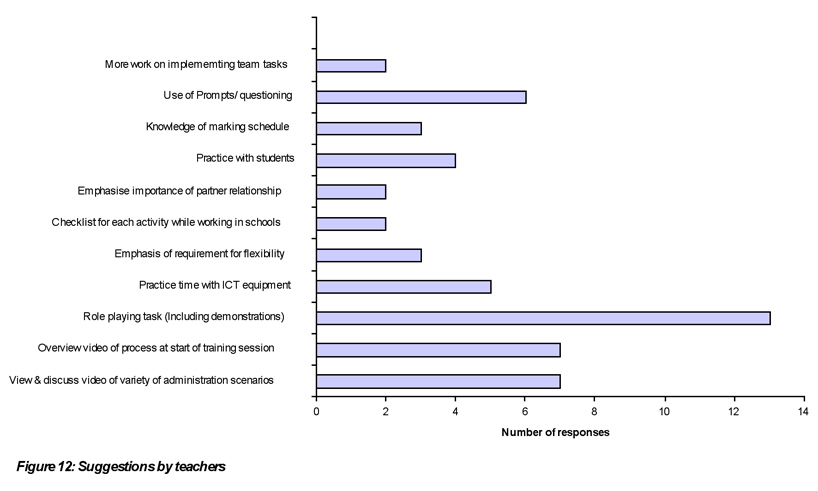
up the equipment and using it appropriately. In Questionnaire three,
teachers were asked to suggest ways that they felt they could be prepared
more effectively to work as an administrator. The idea of role playing
was identified by a number of teacher administrators in order to help
them grasp the implementation of a variety of aspects of their role.
This is shown in Figure 12 below. |
 |
| Comments
to support this idea include: |
| TA8-8: |
I would have liked to experiment a bit more, with probably…and I don't
know how you'd do it…we talked about it this afternoon, whether you
could have children, but then we decided on sort of a mock up situation
more. Today we had a mock up situation where we were the students
and we sat down on the floor and we did a group situation. And had
we not done that we wouldn't have asked the sort of questions. Until
you're put in a situation… you have a feeling…if it's just read and
you read through it, you don't see some things until you get down
and actually do it |
| TA8-13:
|
The
other thing I would have liked was if there had been a role play.
If the lecturers, our teachers as it were, if they'd actually done,
right at the beginning, if they'd said, “Right we're going to look
at the 1-1…” and actually showed us right from, “take the sticker
out, stick it on that child's book”… if that could have been done
for each area, I would have felt better. Rather than it being broken
up into “now these are the task questions” and a couple of days
letter “now this is the administration for that”… So I thought it
could have been better put together. It would have helped me, anyway.
I'd have felt
happier if I could have put all the pieces together, and given that
a run through…that would have helped me.
Even better
would have been one of the lecturers spending 5 or 10 minutes with
each of us, if that was possible, use them as a student and then
some feedback that said “well you could have done this…or I couldn't
understand what you said”, you know. That would have been good,
rather than waiting for the first week to go by and then looking
at tapes… it might have been an idea to find some time to do that.
|
| TA8-7:
|
More
time ON the tasks, I know we spent a lot of time
on the tasks; it's been good but it's been a little superficial in
a way. I probably would have liked to do them rather
than just sit there and look through them with a partner, but to actually
do them in a group situation. It puts us on the spot a bit but it
is a good way to learn. |
| TM5:
|
I
think that you need to role play in order to be familiar with the
script and equipment before using it with students. You need to be
familiar with equipment use and comfortable with being on video. |
| |
|
|
|
|
The
administrator role was complex, requiring the interweaving of a
number of new skills into those that the teacher already possessed.
Several administrators had identified the need to role play the
administrator role in order to develop a better understanding of
the role and consequently to be more effective in implementing it.
Role playing is practice; by doing something as though it were for
real, the learner gets to think, feel and act at the same time,
developing a comprehensive and global understanding of the situation
(Shaw, Corsini, Blake & Mouton, 1980: 2). It is a technique that
is used to provide learners with knowledge and skills by allowing
them to experience a nearly real situation and providing them with
feedback information, to better understand themselves and their
behaviour and increase their effectiveness in various situations
(Shaw, et al 1980: 1). It involves realistic behaviours under unrealistic
conditions. When learners are asked to do something with the learning
material that they have read or heard about they are provided with
an opportunity to acquire a fuller knowledge and understanding of
the new information. Role playing is now recognised as a valuable
procedure whenever people need to understand a situation better
or be more effective in dealing with it. One of the most important
aspects of role playing is that it provides a simulated reality
experience in which a complete skill can be rehearsed without hurting
oneself or others through failure (Shaw, et al 1980: 2-8).
Although trainee
administrators may appear to have an understanding of the administrator
role from reading and discussion, there is often a difference between
'knowing that' and 'knowing how'. Shaw et al (1980: 8) suggest that
there is often a discrepancy between what a person knows and how
they behave. Role playing can be helpful in encouraging changes
in behaviour, either through the opportunity for practicing a new
behaviour or through the use of feedback. Administrators acknowledged
the need for feedback to enable them to modify existing behaviour
to accommodate the new role.
Role playing
also puts the emphasis on personal concerns or problems. Often training
procedures can be too abstract or too general, or they focus on
hypothetical or typical problems. Through role play relevant, personal
concerns can be identified and addressed through feedback and reflection
(Shaw, et al 1980: 21). This was certainly acknowledged by the administrator
who commented, “And had we not done that we wouldn't have asked
the sort of questions. Until you're put in a situation… you have
a feeling…if it's just read or you read through it, you don't see
some things until you get down and actually do it” (TA8-8).
|
| |
|
|
|
|
| a1.12
Viewing video scenarios |
| Figure
12 in Section 1.11, shows suggestions made by teachers on how to enhance
their role performance. The suggestions included areas they would
like more training on and strategies that could enhance their skills
and understanding of the administrator role. Several administrators
identified the need to view video recordings of NEMP assessment procedures
in order to clarify their understanding of the role. Viewing video
recordings was also identified as being useful for providing examples
of how to set up the administration. Comments to support these ideas
included: |
| TA8-3: |
One thing I'd have liked to have done was seen some good models; so
maybe video of teachers showing good practice in their role for the
different areas. Maybe in the middle of the week or towards the end
of the week, show a couple of teachers performing the tasks with excerpts
to show how they go about the process, the prompting, how to get the
most out of the kids; that would have been really powerful, I think.
|
| TA4-4: |
Spending more time with setting up your area, how you might have your
equipment (on the side, at a table). Maybe seeing video clips that
show this …seeing how the administration is set up rather than just
seeing the interview. |
| TA4-7:
|
I
would have liked a holistic overview…I likened it to a jigsaw; I like
to see the picture before I start. On the first day we had a bit of
this and a bit of that but I wasn't quite sure of the whole picture |
| |
|
|
|
|
| Teacher
markers, who had been through the training and administration process
and then subsequently participated in the marking process, also reiterated
these ideas: |
| TM2:
|
A
short video of a good example of a set up that is well set up, that
it's clear to hear and that the children are actually speaking well
so that it gives the quality tapes for the markers. We have seen examples
this week where the students are not all in the picture, or all four
in the group are there, but they are so far away that you can't tell
who's talking, which is important if we are doing marking on how many
people in the group are participating. Also if we had pictures and
the child said, “well this is a good one because…” and a lot of administrators
said, “Ah, that's the such and such a picture…”, but some didn't,
which makes it really hard to know what we are assessing. So, if we
had just seen a video and those sorts of things were pointed out to
us that 'that's really good practice', I think that we could have
done a lot better at times, all of us. |
| TM3: |
I think it would be good to watch video footage and discuss “this
is a good way of administrating because…or this is not such a good
way”, so that we actually get a bit of an insight, I think, visually.
Have a few sessions as part of our training, to give us a little bit
more insight…I think that would have been helpful. |
| TAJ14: |
Perhaps see a short clip of a good video interview so that we could
be more aware of camera distance, group shots and teacher role - what
we should aim for. |
| |
|
|
|
|
| Although
there are differing ideas as to when the videos should be shown there
was a consensus that they would be a valuable addition to the training
programme. Comments to this end had also been made by Year 8 teacher
administrators on their NEMP evaluation forms, completed at the end
of their training week. As a consequence, NEMP had made some video
clips available for the Year 4 trainee teacher administrators to watch
during their break times. There were positive comments made about
this: |
| TA4-8:
|
Enjoyed
the videos of good practice…that was excellent; it was worth its weight
in gold. I learnt this week that I am definitely a visual learner;
I like to see things in front of me so to see possible scenarios and
how people dealt with them was excellent. |
| |
|
| Using
these video clips had also been identified by some NEMP staff as being
worthwhile: |
| NEMP2:
|
Definitely
- we got comments back that they would like to see it on the first
day as a whole group, and I've always thought that too. Most went
and watched them, which was really good. Maybe when we go up and trial
tasks in Auckland, we might film a bit of how 'stations' works and
how 'independent' works, because that's not something that's on those
tapes. If it could fit into the programme early in the week it would
be really good. I've always thought that. It would settle their mind
and it would stop me having to answer lots of those questions in that
first session. |
| NEMP3:
|
Yes,
there was a lot of feedback that they went really well…good practice
and modeling needs to be brought into a sharper focus. I think it's
critical that it is built into a specific session. It should probably
come up right at the first meeting and reinforced in a later session
once they've built up a better understanding of the whole process. |
| NEMP4:
|
Definitely…we
had heaps and heaps of positive feedback about it. It was beneficial
in lots of ways… even an exemplar you could find faults with… shows
that the job is not that easy… shows a good model. Even though the
tapes were made available for the teachers to view independently in
break times or in the evening, not many had seen them until I included
them at the end of the week. They commented that it would have been
good to have seen them earlier in the week, which of course they could
have done. We got through the 1-1 stuff with enough time for 3 of
the 4 groups to have that viewing. It was at the end of the week.
But in some ways it wasn't a bad time to do it as they were at a point
which they had enough of a schema to actually slot in what they were
seeing… I played them and we stopped them and talked about them… I
think we could have more and I can't see why it can't be in that first
session, just, “This is what it looks like, this is a 1-1, here's
a team, this is what we're talking about and you will see more of
these in a more structured way later”. |
| |
|
|
|
|
Risko,
Yount and McAllister (1992) have suggested that viewing video tapes
enables learners to acquire mental models of authentic situations
which helps prepare them for entering similar situations themselves.
However, in order for video to be an effective part of a training
programme it is important that it is selected with particular learning
outcomes in mind that help progress towards the programme's goals
(Brophy, 2004: x). It has been suggested by R.J. Spiro that video
tapes are best viewed in relatively short clips, often as short
as one to three minutes (Spiro and Jehng, 1990: 163-205). However,
the clips are repeatedly viewed and discussed, attending each time
to a different feature or perspective of the situation being viewed,
for example, physical layout, questioning by the teacher, encouraging
student response. The permanence of video allows the trainer to
select a particular focus of attention knowing that the opportunity
to return to other issues is there. Brophy also emphasises the importance
of scaffolded group discussion after viewing a section of video
tape in order to allow trainees the opportunity to reflect on pertinent
issues from the clip (Brophy, 2004: 296 & 303). This allows exposure
to a variety of comments, questions and opinions, creating a richer
experience for trainees than they would have had from viewing the
clip alone. Viewing in isolation, without the assistance of a facilitator,
means that viewers are limited in what they take from watching a
clip by their prior personal knowledge and experiences. Viewers
can also react judgmentally to what is seen, judging a performance
as either good or bad. Facilitated viewing can shift the focus from
generic judgmental responses towards more analytical discussions
of what is viewed.
The administration
process affected teachers' perceptions of their role in a number
of ways: it reinforced their initial perceptions of the need to
be organised and to have developed a good rapport with students
(Section 1.8). It focused administrators on the importance of the
role of ICT equipment in implementing the tasks, on the need to
focus on students' efforts and not their performance and on the
importance of the methods of administrating the tasks (Section 1.7).
Administrating also caused teachers to discover areas that they
had not perceived to be significant in their administrator role,
such as the need for flexibility and the importance of a good collaborative
partnership (Section 1.8). It caused a conflict in their perceptions
through the need to be able to question and prompt students when
instructions were not fully understood, without compromising the
assessment process (Section 1.10) Participating in the administration
process enabled teachers to identify ways in which the training
could have better prepared them for the role, such as using video
scenarios and role play (Section 1.12). |
| |
|
|
|
|
| a1.13
Understanding of Assessment |
Teachers'
perceived that working with NEMP would be an opportunity for professional
development in the area of assessment, enable them to develop their
knowledge and understanding of assessment practices (Section 1.0).
It was noted that the majority of teachers chose to apply for the
position of administrator because they were interested in one or
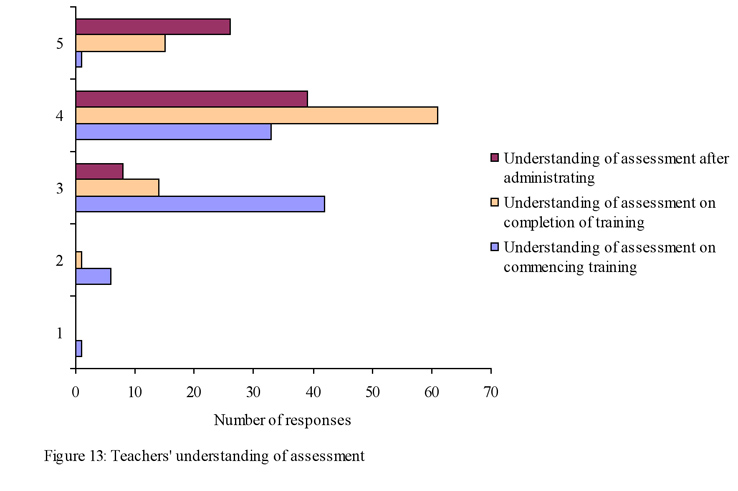
more of the curriculum areas being assessed (Figure 1). Responses
to the three questionnaires monitored teachers' perceptions of their
understanding of assessment before and after training and on completion
of administrating. It was apparent that teachers felt they developed
confidence in their knowledge and understanding of assessment. This
corroborated the findings of Gilmore's research on the benefits
of NEMP as professional development for teachers (1999). She found
that the majority of teachers in her study had gained general ideas
about assessment, gained confidence in methods of assessment and
had developed their repertoire of approaches to assessment (pp.
30-33).
Figure 13 below
shows teachers' confidence about their knowledge and understanding
of assessment before and after training and at the end of administrating.
|
 |
| a1.14
Teacher markers' ideas on important skills for teacher administrators |
| Marking
NEMP assessment data also affected teachers' perceptions of the administrator
role. A small group of teachers who had completed the administrator
training and had worked as administrators were identified as being
involved with the marking of these tasks. After completing the marking
in January 2006, their views were sought as to the most important
skills necessary for a NEMP administrator. The skills identified during
interviews were: |
| • |
Developing a good rapport with students |
| • |
Being organised |
| • |
Sticking to the script |
| • |
Facilitating and not teaching |
| |
|
|
|
|
| Comments
from interviews include: |
| TM1: |
You have to establish a relationship with the children so that they
feel comfortable and are happy to be there Organisation is important…everything
needs to be out before you start Understand the reason why you are
doing the testing - so that you have an idea of the importance of
asking the question properly so that you get a satisfactory answer…the
importance of sticking to the script |
| TM2:
|
Rapport
is so important… making them feel at ease so that you get the best
out of them Keeping to the script - so that it is consistent with
everybody Facilitating not teaching - encouraging them to give the
best answers they can |
| TM3: |
Developing a rapport with children; the way that you are sitting and
your body language. Getting a 'feel' for the child so that you know
when to move them along, give appropriate prompts, that kind of thing. |
| |
|
|
|
|
The
teacher markers had retained their initial perceptions of being
organised and building a rapport with students, as well as incorporating
skills and understandings from the training process. From the perspective
of the marker, the idea of following instructions and sticking to
the script in order to follow the NEMP process was identified as
being more important than it had been at the end of the administration
period (Figure 8). Working in a facilitating role was considered
to be important by the teacher markers. Although teacher administrators
had considered this to be important at the end of their training
week (Figure 6), it was less important to them at the end of their
administration period (Figure 8). The teacher markers viewed a considerable
amount of videoed assessment data. They observed a variety of teachers
working in their new role as administrators, interacting with students
and implementing the NEMP assessment process. Through marking the
data they gained a better understanding of the purpose of the administrator
role. It seemed that viewing these situations from the perspective
of a marker analyzing data enabled teachers to develop a more thorough
understanding of what is required from the administrator. It enabled
them to identify what skills are necessary to implement this role
effectively in order to obtain comprehensive data. Therefore it
may be that in order for teachers to develop a more thorough understanding
of the purpose of the administrator role they have to participate
in both practical learning experiences and view video scenarios
of the role. This would enable them to understand the complexity
and challenges of the role and identify the skills and strategies
that need to be integrated in order to perform the role successfully.
|
