|
a1.4.
Teachers' perceptions of the most important skills at the end of
training
|
| After
looking at the skills and understandings learnt by teachers during
their training, discussed in Section 1.3, it was necessary to look
at how NEMP administrator training affected teachers' perceptions
of the role. Their responses to the second questionnaire confirmed
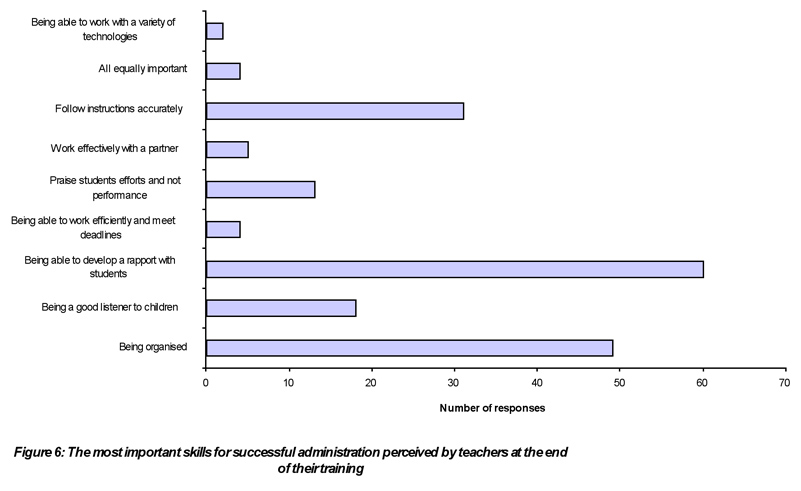
that having a good rapport with students and being a well organised
person were the most important skills for successful administration.
Teachers retained their initial perceptions about the administrator
role. This is shown in Figure 6. |
| |
| Teachers
still acknowledged that following instructions accurately was an
important skill for an administrator. However, at the end of the
training period, being a good listener to children had decreased
in importance. This may be due to teachers realising that their
role did not require them to mark and grade the assessment data
they collected and therefore they did not attach as much importance
to hearing student responses. |
|
|
|
|
|
| a1.5
Skills teachers felt most confident about at the end of the training
week. |
| Having
identified the skills that teachers perceived as the most important
for successful administration in Section 1.4, it was interesting to
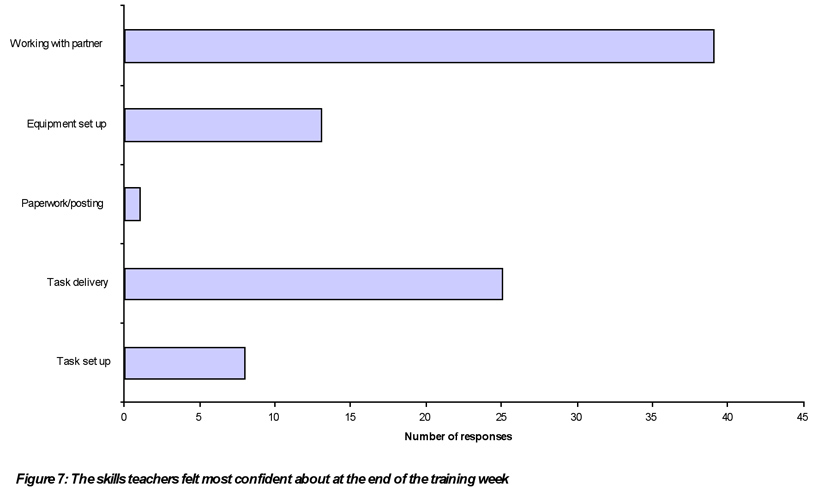
see what skills they felt most confident about. At the end of the
training week administrators rated 'working with a partner' as the
thing that they felt most confident about being able to do, as demonstrated
in Figure 7. |
 |
| Several
teachers acknowledged the importance of working effectively with a
partner in order to implement the assessment tasks successfully. Their
reasons were: |
| • |
the opportunity to share and clarify ideas |
| • |
working with complementary strengths |
| • |
being able to monitor each other to eliminate errors |
| • |
collegiality |
| • |
being able to share and consequently vary the tasks administrated
|
| • |
having a duplicate set of equipment |
| • |
being able to problem solve issues with someone |
| • |
gave mutual support and confidence |
| |
|
|
|
|
| Some
journal entry comments relating to effective partnerships were made
during administration. These confirmed teachers' ideas about the importance
of successful collaboration: |
| TAJ13:
|
I
got to know my partner really well and have enjoyed the professional
discussions on a range of topics. I don't think it would be much fun
doing the admin on your own - walking into a new school on your own
would be hard, as some staff look at you with suspicion. It's good
to bounce ideas off and problem solve together. |
| TAJ7: |
The smoothness of administration depends on how well you work with
your partner. Shared work load is very important in terms of task
allocation. Task allocation did appear to be fair in most cases. |
| TAJ9: |
(My partner) and I are both well organised people who are
prepared to give and take. From my perspective, neither of us seems
to dominate. When one of us is busy the other is able to use her initiative
and help our day/week run smoothly. |
| |
|
|
|
|
| Teachers
acknowledged that a positive collaborative relationship was beneficial
to the administrator role. The mutual support that a constructive
partnership provided enabled the administration of assessment tasks
to run more smoothly and provided a sense of collegiality when working
in changing environments. |
| |
|
|
|
|
| a1.6
The NEMP experience |
| Teachers
had identified the skills, ideas and understandings learnt during
the training (Section 1.3) and at the end of their training had discussed
their perceptions of the most important skills needed in the administrator
role (Section 1.4). On completion of their training as a NEMP teacher
administrator, teachers experienced a high level of satisfaction.
Teachers reported that the training programme was highly organised,
the assessment tools were well constructed and relevant. They found
the NEMP staff knowledgeable and helpful. The majority of teachers
felt confident about entering schools and working with children on
the assessment tasks. The following comments reflected these things: |
| TAJ7:
|
The
training was outstanding…the information presented was excellent,
although after day two I was thinking, “what have I got myself into?”
There was a lot to take in, but a fair bit of head space was given.
The preparation (training) was well organised. A lot of information
was covered, but it is all in the Admin. Manual; this is an excellent
working document and point of referral. |
| TAJ6: |
The training has been pretty thorough…there have been long days, two
of them in particular. I think there has been a good balance between
the areas. |
| |
|
|
|
|
| Teachers
left the training week knowing that if they experienced any concerns
or difficulties, they could contact any member of the NEMP team on
the free 'phone number, which they found reassuring. |
| TAJ5: |
I felt confident after that, that I could always contact someone at
NEMP base. It's very reassuring. |
| TAJ25: |
The 0800 number does give me confidence that help is at hand. Otago
staff are very, very helpful. |
| |
|
|
|
|
| These
comments repeat those reported by Alison Gilmore (1999) in her study
of the benefits of NEMP as professional development for teachers.
Gilmore found that “the professionalism and support from the NEMP
team was commented on frequently (35%). In contrast the number of
negative comments relating to the training week was very small. The
most commonly expressed concern (by 18% of TAs) related to the intensity
of the workload” (Section 3.1.1). Support from the NEMP office was
also identified as being important: “The consensus view was that it
was good to know that help was readily available from NEMP, which
was generally described in positive terms such as reliable, efficient
and professional (46%)”. |
| |
|
|
|
|
| a1.7
Important skills acquired from training identified at the end of the
administrating period. |
| At
the end of the training the majority of teachers felt confident about
working in the administrator role as discussed in Section 1.5. They
spent the next five weeks in schools, working in this role and implementing
assessment tasks. As well as completing the third questionnaire, a
number of administrators kept a journal and recorded their experiences
throughout the five weeks. In the questionnaire teachers were asked
to identify the most important skills that they had acquired from
training that enabled them to work effectively in their role.
This required teachers to reflect on both the training process and
the administration period and decide on the most important skills
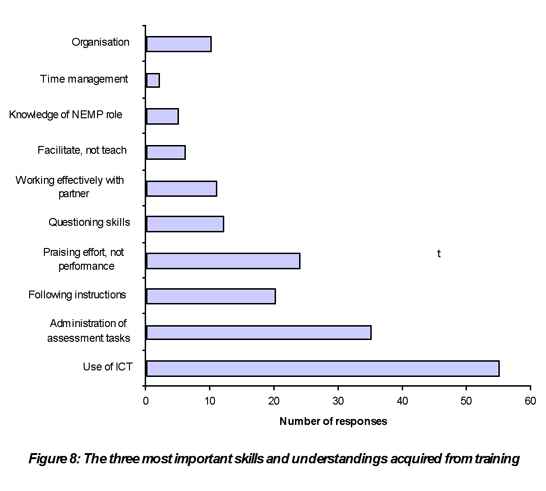
they had learnt for implementing their new role. Their responses are
shown in Figure 8. The skills seen as being the most important were: |
| • |
the ability to use ICT effectively to implement tasks and record data
|
| • |
the methods for administrating tasks |
| • |
praising student's efforts and not performance |
 |
It
is apparent that the training process enabled teachers to acknowledge
and incorporate some of the skills and understandings that NEMP
staff identified as being essential to implement the assessment
programme effectively. The ability to use ICT equipment had been
noted as a skill that teachers needed to learn (Figure 4). They
identified it as a skill that they had learnt during training (Figure
5). At the end of the training, although ICT skills were identified
as an important skill to have learnt, being able to work with a
variety of technologies was not perceived as a significant skill
for the administrator role. But, by the end of the administration
period, the use of ICT equipment was identified by most teacher
administrators as being the most important skill acquired from training
that was necessary to implement their role successfully. It seems
that participating in the administration process changed the perceptions
of aspects of the role for many teacher administrators.
Following instructions
was initially perceived to be an important facet of the administrator
role (Figure 2). It was identified by most teachers as being the
most important skill/understanding learnt during the training (Figure
5). After working in the administrator role, following instructions,
although still acknowledged as being a necessary skill for implementing
the assessment tasks had declined in importance (Figure 8).
Praising students'
efforts not performance was acknowledged by some teachers to be
important in their initial perceptions of the administrator role
(Figure 2). It was also a significant skill/understanding taken
up by teachers at the end of the training week (Figure 5). Administrating
the assessment tasks confirmed to a number of teachers that praising
students' efforts not performance was an important skill to use
in the administrator role (Figure 8).
Although the
administration of tasks was not rated by many teachers as being
an important skill learnt at the end of training (Figure 5) they
felt confident about delivering the assessment tasks (Figure 7).
Figure 8 shows that after administrating, many teachers felt that
the administration of assessment tasks was an important skill to
have learnt.
However, teachers
also identified other skills that they found to be important to
them in order to implement the assessment procedure that they considered
had not been part of the training process and some which had not
been part of their perceptions of the role. These are discussed
in the next section. |
| |
|
|
|
|
| a1.8
The most important skills required in the teacher administration role
|
| As
well as identifying the most important skills acquired from the
training programme, (Section 1.7), Questionnaire 3 also asked
teachers to identify the most important skills they perceived necessary
to perform the administrator role. Again this required teachers to
reflect on both their training process and their administration period
and think about the skills that their new role required. The most
important skills identified are shown in Figure 9 below: |
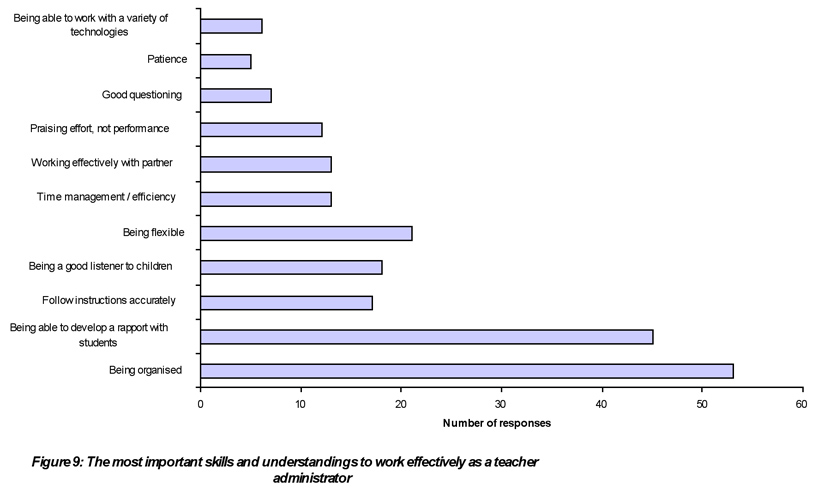 |
| The
most important skills identified were: |
| • |
being organised |
| • |
developing a good rapport with students |
| • |
being flexible |
| • |
working effectively with a partner |
| • |
being a good listener to children |
| • |
following instructions accurately |
| • |
focusing on students' effort not their performance |
| |
|
|
|
|
Being
organised and having a good rapport with students reflected teachers'
initial perceptions of the teacher administrator role as shown in
Figure 2. Teachers retained these initial ideas, which were affirmed
by experiencing their new role. Being organised (including having
good time management and working efficiently) and having a good
rapport with students are essential components of the teaching role,
which teachers acknowledged they brought with them to the administrator
role (Figure 3).
Focusing on
students' effort and not their performance was confirmed by a number
of teachers as being a necessary skill to have. Following instructions
accurately was also identified as being necessary, although its
importance had declined (as discussed in the previous section).
Being a good listener to children was part of teachers' initial
perceptions of the role. Although this declined in importance by
the end of the training period (Section 1.4) it maintained that
level of importance at the end of administration. The importance
of working effectively with a partner was included in a few teachers'
initial perceptions of the role (Figure 2). A number of teachers
thought that they had the skills of working effectively with others
(Figure 3), although it was identified as a skill some felt they
need to learn (Figure 4). Some teachers acknowledged that they were
able to develop a relationship with their partner during training
(Figure 5). Although many teachers felt confident about working
with a partner (Figure 7), the importance of a successful collaborative
partnership was not realised by many teachers until they actually
experienced working in the administrator role (Figure 9).
Although many
skills learnt in training were acknowledged as being important in
the administrator role, there were some skills that were not part
of the training process and not part of teachers' perceptions of
the role. At the end of the administration period the need for flexibility
had arisen as being an important skill to have. This had not formed
part of teachers' perceptions of the role at any stage. The need
for teachers to be flexible in the administrator role had been identified
by a member of the NEMP team (Section 1.1).
When also asked
in Questionnaire 3 to identify what was the most difficult aspect
of the administrator role, the need to be very flexible and work
effectively with a partner were identified as the most common difficulties
experienced by administrators. These are discussed in the next section.
|
| |
|
|
|
|
| a1.9
Difficulties experienced by teachers when working in the administration
role. |
| The
difficulties that teachers experienced when working in the administrator
role are shown in Figure 10. |
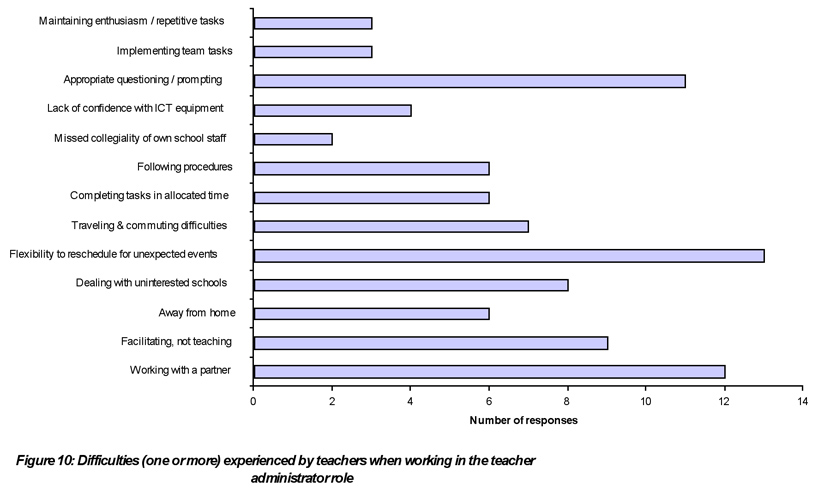 |
| It
seems that some teacher administrators were not aware that the administrator
role required a high degree of flexibility in order to accommodate
such things as individual student issues, school timetabling difficulties,
the impact of the school programme and unforeseen events. At the end
of the five weeks in the administrator role, a number of teacher administrators
included the need for flexibility as an important skill. These teachers
did not include flexibility in their perception of the role. They
felt that it should be focused on during the training process. Comments
to this effect include: |
| TAJ3: |
The role is different from what I expected…we need to make organisational
decisions and be flexible to enable tasks to be completed in this
tight timeframe. I have realised that a lot more flexibility and initiative
needs to be used. Some tasks are not cut and dry and there is the
need to work with and adapt to different children, schools and situations. |
| TAJ26: |
A rapport with students is essential, and organisational skills are
important. I do feel flexibility is more valuable than was indicated
in training - adapting to schools, prior bookings, e.g. cross country,
production, outside visitors. |
| TAJ17: |
My partner and I are working well together. We are both well organised
and flexible - probably the two most important skills required. |
| |
|
|
|
|
The
concept of flexibility is antithetical to following instructions
and following the methodical implementation of the NEMP process
that is a focus during the training week. Consequently, some teachers
had difficulty working with the two ideas. This is known as role
ambiguity, and is experienced by people when expectations within
a role are incomplete or insufficient to guide behaviour (Biddle,
1979: 323). Although some NEMP staff addressed timetabling issues
and provided anecdotal evidence of situations that may occur, it
may be that the need for flexibility has to be made more explicit.
This will serve to place the idea that flexibility is part of the
required role in the mind of the administrator so that it becomes
a shared expectation (Biddle, 1979: 117). As flexibility may not
be a skill that can be taught in a week, such as is given for the
NEMP training programme, it may well be essential to include 'flexibility'
as a prerequisite in the advertisements and information package
that NEMP uses to recruit teachers. Teachers commented to this effect
in Questionnaire 3, when identifying the skills that NEMP needed
to look for when selecting their administrators. Clarifying expectations
at an early stage in the preparation process may enable teachers
to adopt a new role more successfully as it becomes part of constructing
their perceptions of that role.
Another considerable
area of difficulty identified by administrators was working collaboratively
with a partner. Although as reported in earlier sections, many teachers
found this a valuable component of working on NEMP, when it was
not successful there was a lot of anguish and frustration. Working
with a partner was a significant change for teachers to make when
adopting the new role of administrator. Many teachers have been
through a 'socialisation of isolation' (Friend & Cook, 2003: 15)
as they have developed their professional skills and abilities.
The culture of many schools is one of independence and self reliance,
reinforced through structural isolation (Friend & Cook, 2003: 13-15).
Individualism may provide teachers with an adaptive strategy that
they actively construct to enable them to manage their relentless
work schedule. It may be due to situational or administrative constraints
which present significant barriers to doing otherwise. It may be
a preferred way of working for a number of teachers on pedagogical
or personal grounds (Hargreaves, 1994: 172-173). Whatever the origins
of working individually, it can be difficult for teachers to make
the transition from working independently to working collaboratively
in a new role, thus affecting the ability to adopt the new role
successfully.
Partner difficulties
included: having different approaches to organizing and implementing
the day; expectations of each other's approach and style which are
not fulfilled; inflexibility of partner; hierarchical relationship
of partnership. |
| TAJ25: |
I would do NEMP again despite having an 'unsatisfactory' partner.
I have missed not being able to freely discuss aspects of the programme
with her. I think being able to do that must be a learning advantage.
I know I have deliberately masked my body language and monitored my
conversation so as not to threaten my partner's position. I have tried
at times to make suggestions and be a co-team member rather than a
follower, especially when I became more confident being a teacher
administrator. But my partner had to be the boss, so I let her be.
I know I am being deliberately agreeable because the tension would
be unbearable if I wasn't, and the important thing is to keep the
programme going…it's necessary! I know I'm doing it, I don't feel
angry about it: it is just a means to an end. |
| TAJ23: |
Getting used to working really closely with someone who approaches
tasks and little things in a different way to me has been a challenge
at times. I respect the fact that she is a senior teacher and has
way more experiences than I do, but sometimes I feel that because
of the difference in age and experiences, she doesn't value my contribution
to things (as in organisation of materials etc.). |
| TAJ6: |
What I am finding a little difficult is working with a partner. Two
organised people often have their own organisation systems. |
| |
|
|
|
|
This
last comment demonstrated one of the tensions involved when skills
considered essential for the role conflict in a collaborative situation.
Although it was necessary to be extremely organised when preparing
for and implementing NEMP's assessment procedures, individual ways
of organizing things may conflict. In situations like this it is
necessary that those involved have developed the skills and strategies
to deal effectively with conflict situations to minimize the impact
of disagreement on role performance.
Administrators
who had experienced a positive relationship with their partner also
made comments concerning the potential difficulties if the collaborative
role was not successful. |
| TAJ17: |
We met up with some fellow 'NEMPers' on Friday night to share some
stories. It made me appreciate that it must be difficult to work with
a partner that you didn't get along with. Several made comments about
differences in style and organisation. |
| |
|
|
|
|
| It
can be difficult for teachers used to working in isolated classroom
situations to make the transition to working collaboratively. A number
of teachers expressed that they should have discussed issues of conflict
with their partner but did not know how to do so, choosing instead
to 'bite their tongue'. Others identified a need to have learnt some
negotiation skills: |
| TM5: |
The training should include how to work closely with another person;
we are so used to working on our own, in our own little classroom,
it is quite difficult working so closely with someone else for a long
period of time. I have talked with a few TA's and no one had a major
bust up, but there were several things that were disagreed on and
maybe learning some negotiation skills would be useful. |
| TAJ12:
|
Forming
a good, professional working relationship is essential. There are
times when it is difficult. (My partner) criticises and tries to alter
arrangements I have made - and this really annoys me. The peace is
kept because I believe that we really do have to get on as a team.
However, it isn't always easy. |
| |
|
|
|
|
At
the end of the five weeks administrating…
At times I
have felt that I needed advice on the difficulties of working
with my partner. I think some of those times have caused me the
only real stress in the job. However, we are expected to work
closely for six weeks with a stranger - in constant close proximity.
I suppose there's bound to be difficulties. Having said that,
I know she has probably found me difficult to work with too. I've
done quite a bit of tongue biting to keep the peace, but inwardly
I've been annoyed. I probably should have brought it out in the
open.
A collaborative
relationship cannot be treated as 'natural' and left to evolve entirely
on its own. It is a purposeful relationship, established with professional
goals in mind, and needs constant maintenance. Communication is
critical in order to clarify misunderstandings and confirm mutual
understandings. Collaboration requires parity among participants,
where each person's contribution is equally valued. It is essential
for individuals to make the necessary adjustments in order that
they have parity as they work together on a specific collaborative
task, even if they do not have parity in other situations (Friend
& Cook, 2003: 6). A perceived disparity in professional ability
seems to have been a cause of partnership difficulties in several
administrator situations. Instances of this occurred when a classroom
teacher was partnered with a teacher from a management background
and the classroom teacher felt that her comments, systems of organisation
and ideas were not valued. It also occurred between teachers with
significant differences in their amounts of teaching experience,
where the more experienced teacher dominated the partnership leaving
the other teacher feeling under-valued.
Salend and Johansen
(1977) focused on the concerns teachers have about working collaboratively
and how they addressed and resolved those concerns. They identified
factors that contributed to the development of successful collaborative
work. They suggested that training in adult-adult communication,
active listening, conflict resolution and problem solving needs
to be provided for adults becoming involved in collaborative work
(1977: 8). Individuals need to learn ways to negotiate working effectively
together that enables honest communication, risk taking, acknowledging
the perspectives and experiences of their partner and letting go
of absolute control (1977: 9). Friend and Cook, (2003:170) acknowledge
that professional educators have been well trained to work with
children but propose that they know surprisingly little when it
comes to the adult-adult interactions that drive collaboration.
They suggest that considerable attention should be given to assisting
educators to develop positive communication skills with other adults.
This enables them to attend to relationship issues right from the
beginning, and as they rise along the way, in order to develop the
trust required to give and receive authentic criticism of one another.
By the end of
the administrating period, more administrators acknowledged that
working effectively with a partner was an important skill to have
developed (Figure 9). It appeared that having performed the role
of teacher administrator and developed a better understanding of
the administration process and the procedures for setting up that
process, the importance of a good collaborative working relationship
with one's partner was reinforced.
Another difficulty
experienced by administrators was questioning and prompting students
appropriately, which required administrators to deviate from the
script. For a number of teacher administrators, 'following the script'
in order to facilitate the assessment procedure was a difficult
task (Figure 10). Administrators recognised the importance of following
the script accurately in order to acquire valid data, and included
it in their most important ideas learnt during the training week
(Figure 5). Most of the difficulties with following the script arose
from the use of prompts and questioning in order to elicit more
information from students (Figure 10). Administrators felt that
they needed more guidance as to what was acceptable prompting if
the 'script' was not comprehended by students, as they were unsure
as to how much they could acceptably deviate from the script in
order to elicit a response. Following the NEMP process accurately
is a crucial part of taking on the administrator role. By acknowledging
it as one of the most important aspects of the role, teachers demonstrate
that they have an understanding of what is required of them in their
new role. However, it seems that in order to adopt the role successfully
there is a need to be prepared differently for this aspect of the
role before they go out and work in schools.
Comments received
throughout the administration procedure include: |
| TAJ17: |
Sticking to the script has been the most difficult, especially when
things are worded in a way that students don't understand. I am not
sure how much prompting is acceptable…I don't think this was covered
in our training - maybe good and/or not recommended exemplars would
be helpful. |
| TAJ13: |
Not sure how much intervention I should be giving to keep students
on the right track - how much to leave them even if they are going
wrong. Got my report - got pulled up on this, so obviously I need
to be more 'hands off' with my prompting. It's good to get that feedback.
Probably more emphasis could have been made on this aspect of training. |
| 2
weeks later |
|
|
|
| |
The
prompting is still something I struggle with. Some suggestions on
a laminated card that you could have in front of you would be useful
- not enough emphasis on this during training. |
| TAJ12:
|
Not
prepared well for how far the prompting can go. In my efforts to get
children to explain ideas I'm worried if I'm over-prompting now |
| |
|
|
|
|
| NEMP
staff also acknowledged that keeping to the administrator script in
the manuals posed difficulties for administrators: |
| NEMP2:
|
Definitely
forcing….you know how they read from the script, they have to stick
to the script but in the end it's sounding very like, rote and there's
no…I think the student's feeling quite isolated in a way sitting there…so
that's not a good thing, I see that quite a bit. Also, their prompting
can be too leading…prompting is very important, that they don't tell,
give answers as they prompt, or they prompt too hard, forcing the
child instead of giving them time; it's very important to give them
time…pretty quickly you've got to have a rapport with that child and
work out exactly when you think they're going to speak…it's quite
hard really. |
| After
watching the first week of Year 4 administrator video tapes |
|
|
|
| |
Prompting
and reiterating the questions was not so good. |
| NEMP4: |
It is difficult to get across to TA's how to rephrase things without
being leading…this leads to the tension between them following the
script and paraphrasing without giving a direction |
| From
comments received it is apparent that following instructions and sticking
to the script in order to follow the NEMP process was a problem for
the administrators. A number of administrators did not successfully
integrate the skills of prompting and questioning appropriately. When
working as an administrator, this caused conflict between how they
perceived their role and what the role seemed to require. As discussed
in Section 1.8 concerning the notion of flexibility, this again appeared
to be an instance of role ambiguity (Biddle, 1979: 323) where there
is insufficient knowledge to guide behaviour. This created difficulties
for the successful adoption of the role. |
| |
|
|
|
|