|
This
research collected data from the 2005 cohort of teacher administrators.
It utilised a series of questionnaires, interviews and journal entries
in order to elicit information about initial and subsequent perceptions
of the teacher administrator role. It focused on interpreting teachers'
changing perceptions as they developed their skills and knowledge
of their role during the training process and throughout their time
working in their new role. Throughout this process teachers were
asked to reflect on their changing perceptions and identify any
information or skills they felt would enable them to perform more
effectively in the new role.
Applications
for the role of teacher administrators were submitted by March 1.
From these applications, ninety six teachers were selected. Half
of these were trained in August and administered tasks to Year 8
students. The others were trained in October and administered tasks
to Year 4 students. The teachers participating in the research had
all applied for the position and can be assumed to be motivated
to undergo training for this role. The teachers came from a variety
of school cultures, from all around New Zealand. They taught or
had taught at a variety of age levels in the primary system. The
teachers came from a range of teaching experience, from less than
five years to more than twenty years.
Once
NEMP had selected the teacher administrators for the 2005 cycle
of assessment, a questionnaire was sent out to all the teacher administrators.
The questionnaires used in this research are included in Appendix
A. The first questionnaire ascertained information on the teachers'
prior knowledge and understanding and expectations of NEMP and their
role as teacher administrator. During the two training weeks, several
teachers from each group volunteered to complete an interview about
their perceptions of the administrator role. This interview was
recorded, transcribed and analysed. On completion of their training
week all teachers were asked to complete a second questionnaire
to see if changes had occurred in their understanding of the role
of teacher administrator.
Both
groups of teachers spent five weeks working with students in a variety
of schools. Whilst working as an administrator, the teachers that
were interviewed were asked to keep a reflection journal, so they
could monitor their perceptions of their role. At the end of the
five week period of assessment a third questionnaire was sent out
to all teacher administrators, to gather data on their perceptions
of their role, after they had completed their administration period.
A
number of NEMP staff were involved with the training of the teacher
administrators: the co-directors of NEMP coordinate the training
process and work directly with teachers during the training week.
NEMP also have other personnel who facilitate the training process;
one of these is contracted by NEMP in the role of 'visiting teacher'
for a year, the others are permanent staff members. One of the directors
of NEMP, the visiting teacher for 2005 and two permanent member
of the NEMP team were asked to participate in an interview before
the training process began, in order to ascertain the requirements
that NEMP had for their teacher administrators. Further interviews
took place after each training week, once video tapes from the first
administration week had been viewed, in order to establish if there
were any changes to, or conflicts of the expectations of the teacher
administrator role for NEMP staff. The interviews were recorded,
transcribed and analysed.
In January 2006, some of the data from the 2005 NEMP assessment
cycle was marked. Often, teachers who have worked as administrators
during the collection of the data, apply to work as teacher markers.
Part of the marking process requires the markers to watch videotaped
activities of students working on assessment tasks. Teacher markers
then grade performances against set criteria. The videotapes show
the teacher administrators explaining the assessment tasks and working
with students in order to obtain detailed data. Markers view a variety
of teacher administrators, all of whom participated in the training
process. Teacher administrators who chose to be part of the marking
process were identified and asked to participate in a further questionnaire
and interview, after their marking week. Their perceptions of the
administrator role after completing the marking process were recorded
and analysed.
The
Grounded Theory approach was used to gather and analyse the information
provided through the questionnaires, interviews and reflection journals.
The systematic collection and analysis of data generated from the
research enabled the conceptualization of fundamental latent patterns
occurring in the research situation, enabling generation of theory
(Glaser, 2003: 189). Patterns in the responses emerging from the
questionnaires and interviews, along with anecdotal evidence given
by the teacher administrators during the various stages of their
learning and application of their role were noted. Concepts indicated
by the data were used to guide the analysis of information. Theories
were then generated from the analysis of emerging patterns, to explain
the data. The theories derived from the data were verified through
comparison with literature from previous research. Collectively
they describe the tensions and challenges faced by the teacher administrators
and how those administrators perceived, interpreted and translated
their new role into practice.
|
|
|
|
|
|

CHAPTER 3 : Results and Discussion |
The
following section provides an analysis of the information obtained
from interviews, questionnaires and journal entries, grouped into
common themes and issues as they arose. The first two sections report
on the reasons for teachers wanting to work as a teacher administrator
and their initial perceptions of this role. These included the skills
they felt they needed to work as a TA and the skills they brought
to the position that they felt were important. Their perceptions
of the role and the importance of various skills were then analysed
at the end of the training period and at the end of administrating.
Subsequent sections deal with aspects of the administrator role
that teachers had not realised were important, but became so as
they worked in their role. These included: the need for flexibility;
the importance of developing a positive collaborative working relationship
with their partner; the importance of constructive feedback during
the training and administration process. Teachers also suggested
ways that would better prepare them to understand and implement
the administrator role. The final section discusses teacher markers
perceptions of the administrator role.
Comments
from NEMP staff on these themes were integrated. Comments made by
teachers and NEMP staff were coded in the following way: |
TA4 |
- interview with Year 4 teacher administrator |
TA8 |
- interview with Year 8 teacher administrator |
TAJ |
- journal entry from teacher administrator |
TM |
- interview with teacher marker |
NEMP |
- interview with National Education Monitoring Project staff |
| |
|
| a1.0
Reasons for becoming a teacher administrator |
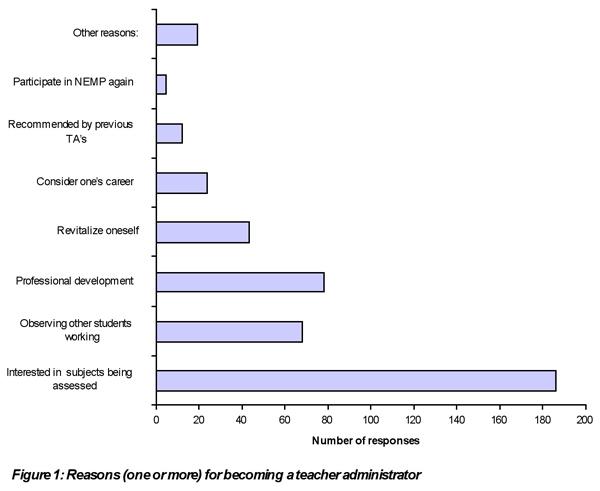
Figure
1 shows teachers' reasons for applying to become a teacher administrator.
Some people had been administrators on previous occasions and wished
to repeat the experience; some had colleagues or friends that had
worked as teacher administrators and had recommended the experience
to them. For some teachers, NEMP provided an opportunity for them
to visit and observe other students in other schools. Having the
chance to be out of regular classroom work in order to revitalise
oneself, or consider other career opportunities were also significant
reasons. The majority of teachers chose to train to be an administrator
because they were interested in one or more of the curriculum areas
being assessed. They perceived the role would provide professional
development opportunity in assessment of those curriculum areas. |
 |
| a1.1
Teachers' initial perceptions of the teacher administrator role. |
| The
reasons teachers gave for becoming a teacher administrator provided
insight as to how they perceived the opportunity of working in the
administrator role. This section examines in more detail the skills
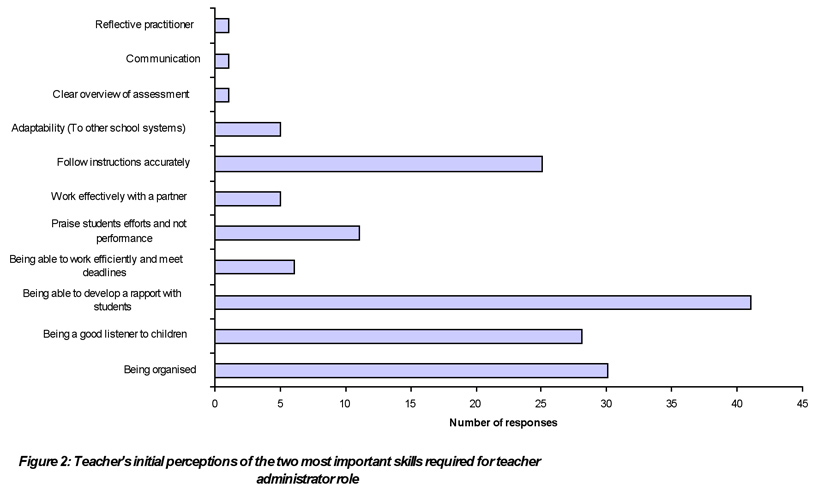
they perceived to be necessary in this role. In the first questionnaire
completed before commencing the administrator training programme,
teachers perceived that the most important skills for a teacher administrator
were to have the ability to develop a good rapport with students and
to be organised in order to work efficiently. They identified that
being a good listener to children was also important and recognised
that an ability to follow instructions would be beneficial to the
role. These ideas formed the teachers' initial perceptions of the
administrator role. These initial perceptions are represented in Figure
2. |
 |
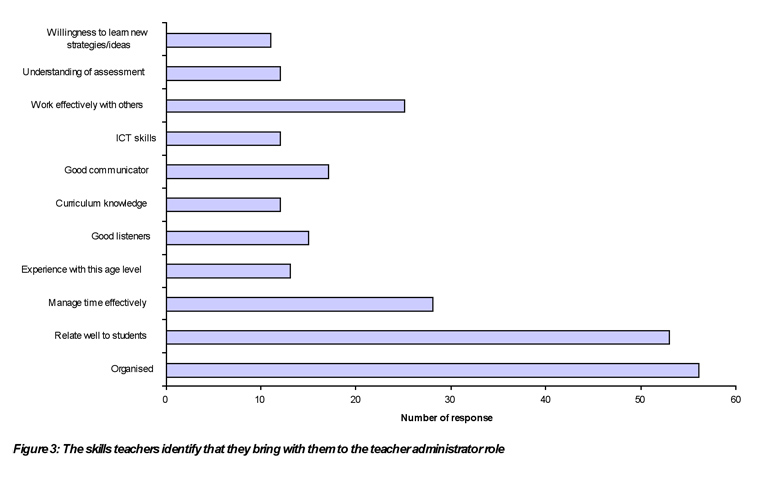
| Teachers
were also asked to identify the skills that they felt they brought
to the administrator role. Most teachers thought that they brought
with them organisational skills and the ability to relate well to
students and to work well with other people. The skills that they
brought with them which they identified as being important also serve
to reflect their initial perceptions and beliefs about the requirements
of the administrator role. This information is represented in Figure
3. |
 |
When
Figure 2 and Figure 3 are compared it appears that relating well
to students, in order to develop a good rapport with them, and being
organised were identified as being important skills required for
the teacher administrator role and skills that most teachers recognised
they brought with them to the role. Although teachers rated working
effectively with others as an important skill they brought with
them, they did not perceive this to be as important in the administrator
role. Being a good listener to children was identified as being
an important skill for the administrator role. Although some teachers
recognised it as a skill they brought with them to the role, many
others did not. This possibly showed an awareness of the skills
that teachers felt that they needed to gain to be effective teacher
administrators. Teachers perceived the ability to follow instructions
accurately to be significant for implementing the administrator
role. However, it was not identified as a skill that teachers brought
with them to the role. . This may also have been something they
felt they needed training in.
In their initial
interview, all NEMP staff identified that having a good rapport
with students was crucial to performing well in this role and that
being well organised was essential for administering the tasks efficiently.
This corresponded with the skills that teachers brought with them
to the role and with teachers' initial perceptions of important
skills required. NEMP staff also included the importance of developing
a good rapport with colleagues. Teachers perceived that this was
a skill they brought with them (Figure 3) but did not put much emphasis
on it for the administrator role (Figure 2). |
| |
|
| NEMP
1: |
We're looking for teachers that can establish good rapport with colleagues
and with children…that have good relationships… that's high in the
rankings. Another factor is that they can work methodically and efficiently;
as you know, NEMP is a very well defined packaging of procedures and
so on, and in order to maintain high levels of consistency at a national
level of gathering information, that's quite important. |
| |
|
| Having
knowledge of the curriculum areas they were involved with and an interest
in assessment in those areas was also a factor for NEMP staff. |
| |
|
| NEMP
1: |
That
they've got an interest in the subject areas that we're assessing.
We don't expect them to be specialists, but we expect them to have
a…a healthy interest in curriculum…and, well most teachers do really,
but most years you'll find a teacher's got a particular interest…in
other words, that there is some motivational factor there that's related
to the curriculum, as part of their reason. Also, their interest in
developing their understanding about assessment. |
| |
|
The
majority of teachers chose to train to be an administrator because
they were interested in one or more of the curriculum areas being
assessed. They perceived the role would provide professional development
opportunity in assessment of those curriculum areas (Figure 1).
These initial perceptions of teachers corresponded to the requirements
of NEMP.
One member of
the NEMP staff also identified patience as a key requirement and
another member thought that flexibility was vital. |
| |
|
| NEMP
2: |
Well, probably the most important is the way they work with students.
That they've got an encouraging, positive approach with a student,
that's especially important to get the best out of them. Also, that
they are patient. Organisation is quite a thing. It's a big issue
to get through all the tasks in a certain time, you need to be really
highly organised. |
| |
|
| NEMP
4: |
They need knowledge in curriculum focus areas. They must be people
who can cope with changing environments… an ability to work with others. |
| |
|
| a1.2
Skills teachers feel they need to learn during the training week. |
| The
previous sections discussed how teachers initially perceived the administrator
role. It identified the skills that teachers perceived they had which
they considered would be necessary to implement that role. This showed
some differences between what they felt were important skills for
teacher administrators and the skills that they brought with the.
This section deals more explicitly with the skills that teachers perceived
they needed to learn during the training week in order to be prepared
for the administrator role. However, the skills that they identified
in this section were not the ones that the previous section suggested
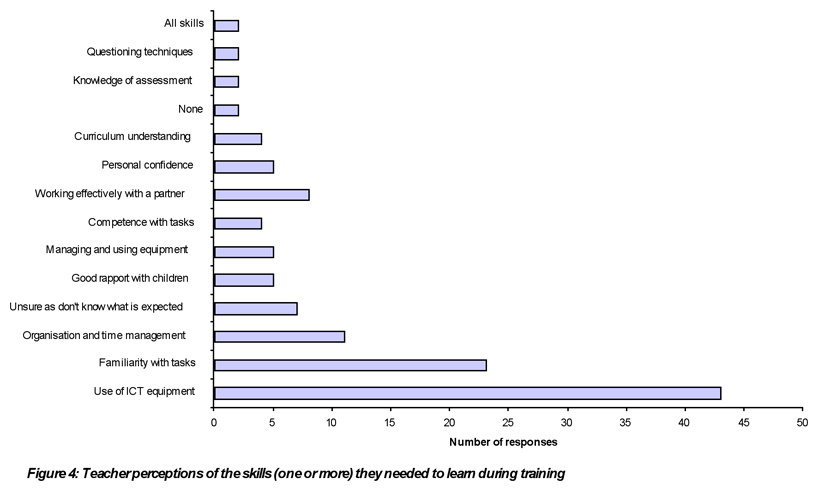
may have been raised. When completing Questionnaire 1, before commencing
the training, teachers were asked to identify these skills. The skills
they felt they most needed to develop during this week were: |
• |
the ICT skills needed to administer and record the assessment process |
• |
familiarity with the assessment tasks |
| |
|
| A
number of people noted that they needed to develop their organisational
and time management skills. A few people felt that they needed to
develop the skills of working collaboratively with a partner. This
information is shown in Figure 4. These skills identified were based
on teacher's prior knowledge of the administrator role. Teachers'
prior knowledge seemed to be informed by the teacher administrator
job specifications contained in the NEMP application pack. In some
instances this prior knowledge may have been influenced by talking
to other teachers who had previously worked as a teacher administrator.
|
 |
| The
NEMP staff identified that confidence to implement the assessment
programme effectively was the aim of the training programme and this
included: |
| • |
the need for the teachers to develop an understanding of the NEMP
process |
| • |
knowledge of the NEMP tasks and resources and how to use the manuals
|
| • |
Knowing how to facilitate the assessment process |
| • |
ICT skills in order to be competent with the equipment. |
| • |
the skills needed to get the best responses from students |
| |
|
| It
seems that before entering the training programme, consistent with
the expectations of NEMP staff, teachers perceived the most important
skills that they needed to learn was the use of ICT equipment and
knowledge of the NEMP tasks and resources. However, at this stage,
teachers did not place an emphasis on a need to develop an understanding
of the NEMP process, and knowing how to facilitate the assessment
process in order to get the best responses from students. These skills
and understandings were seen by NEMP staff as being necessary to implement
the assessment programme effectively. Teachers did identify 'following
instructions' as being a necessary skill for implementing the administrator
role, as indicated in Figure 2. However, they did not include it in
the skills they brought to the role as shown in Figure 3, and they
did not perceive it to be a skill they need to learn during the training
week. The teachers had perceptions about their own learning needs.
However, previous research by Creighton and Johnson (2002) has suggested
that it is not until teachers are actively engaged in a new role do
they realise that there are components and challenges that were not
part of their expectations of the role and not perceived as a learning
requirement. Their findings lead them to posit the need for a safe
practice field to enable learners to get a feel for the role and make
mistakes, which serve to enhance learning and cultivate new beliefs.
The discrepancies noted between teachers' perceptions of what they
needed to learn to implement their new role and the requirements of
that role seem to corroborate the findings from Creighton and Johnson's
(2002) study. |
| |
|
| a1.3
The skills and ideas or understandings that teachers learned during
the training week. |
| After
identifying teachers' perceptions of what they needed to learn in
Section 1.2 it was necessary to consider what were the important skills
they perceived they did learn during their training. At the end of
the training week teachers were asked to complete a second questionnaire.
In this questionnaire they were asked to identify the most important
skills and ideas or understandings that they had learned during the
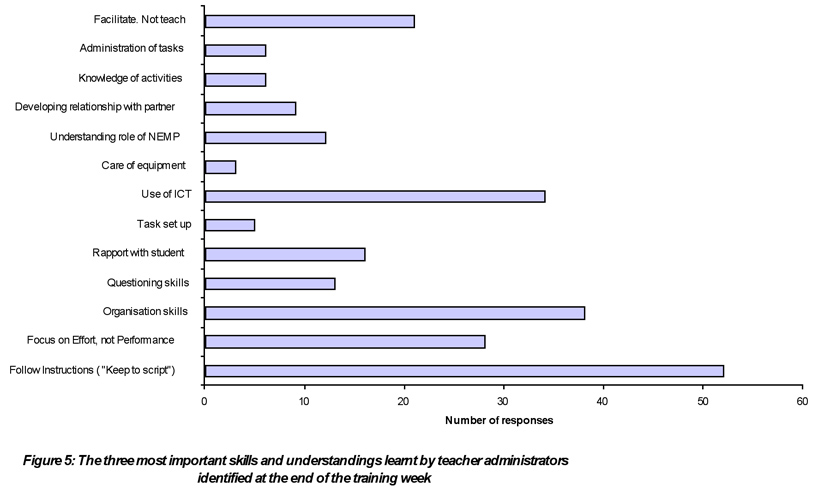
training week. The skills and ideas or understandings identified were: |
| • |
to follow instructions (“stick to the script”) |
| • |
to be organised with the equipment |
| • |
the use of ICT |
| • |
to praise student effort and not their performance |
| • |
to work in a facilitating role and not a teaching role |
| |
|
| Figure
5 shows this information. |
 |
| At
the end of the training period, teachers' comments demonstrated that
they had incorporated some understanding of the NEMP process into
their perceptions of the administrator role: |
| TA8-8:
|
Being
organised, in terms of being prepared; know what you are doing - delivery
of the tasks for example. Being enthusiastic and making the students
feel welcome and at ease. |
| TA8-5:
|
Trying
to divorce myself from the teacher role and be a facilitator. Trying
not to teach, just encourage them to think. I'll have to be careful
with that. It will upset the results that come through by leading
the children in certain directions instead of letting them follow
their own direction and what their own thoughts are. You want to find
out what they think instead of what you think they should think. That
could damage the results more than anything else. |
| TA4-7:
|
Important
to be consistent…to say things in the proper way for it to be valid.
Make sure children feel comfortable so that you get the most out of
it. Make sure the equipment is working. Make sure you keep records
accurately so that data is worthwhile and usable. |
| |
|
Figure
5 shows that being organised with the assessment resources and the
use of ICT equipment were identified as important skills learnt.
These skills were both included in teachers' perceptions of what
they needed to learn, as demonstrated in Figure 4.
The majority
of responses in Figure 5 indicated that following instructions was
one of the most important understandings they thought they learnt
during training. As discussed in Section 1.2, this was not perceived
by teachers as a skill that they needed to learn (Figure 4). However,
nor did they identify it as a skill they brought with them to the
role (Figure 3). This suggested that it was a surprising feature
for them when learning about being an administrator. Teachers also
acknowledged that they were required to change their role from that
of a teacher to that of a facilitator in order to implement the
administrator role (Figure 5). Teachers' perceptions of what they
needed to learn did not include developing this skill (Figure 4).
Other skills and understandings that were not included in teachers
learning needs were focusing on effort and not performance of students
and developing an understanding of the role of NEMP. Both of these
were included as important things learnt during training, as shown
in Figure 5. None of these skills were identified as ones which
teachers brought with them to the role. It would seem from the results
shown in Figure 5 that NEMP training provided teachers with an understanding
of these new aspects of the administrators' role.
However, research
suggests that it is important to acknowledge the effects of teacher
perceptions on the assimilation of new learning. It is necessary
to identify factors that impact on changing those perceptions in
order to enhance the acceptance and integration of a new technique
or role (Smylie, 1988). NEMP requires teachers to change their behaviour
in order to integrate their new role. Teachers have to become facilitators;
they have to focus on students' efforts and not their performance;
they have to follow instructions accurately. Studies have indicated
that in order to make significant changes towards desired behaviours,
training should be systematically focused on sensitising teachers
to a particular skill, and provide practice experience based on
theoretical content, followed up by opportunities for review and
feedback (McGee 1980). |
| |
|